The wire was already there
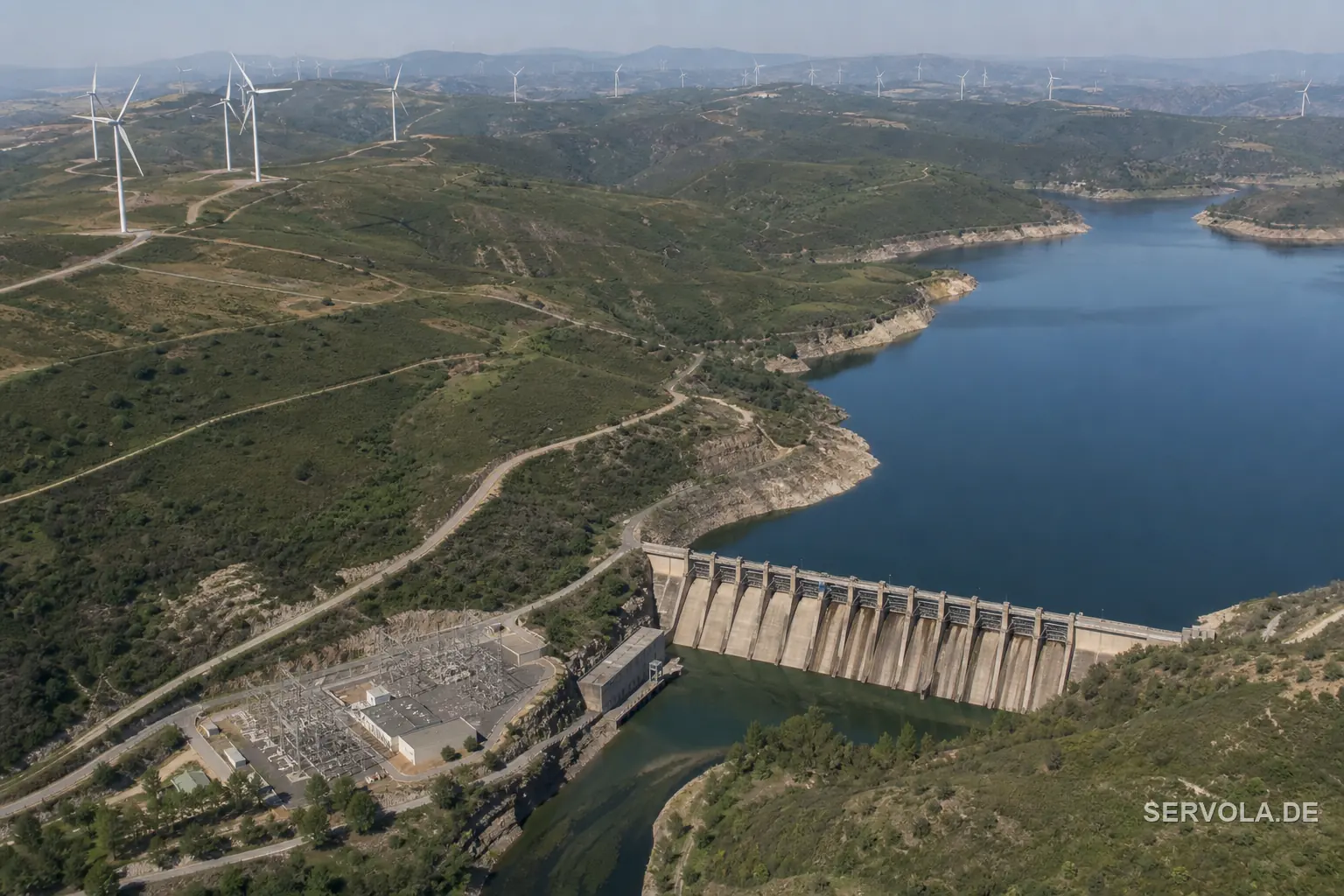
At a reservoir plant in northern Spain the substation, the switchyard and the connection agreement have been in place for decades, and the last of those is now the valuable one. Ember, the energy think tank, published a report on 21 July 2026 titled 'Power on tap: EU hydro giants can add 25 GW renewables without new grids'. Its central finding is stated plainly: "25 GW of wind and solar can be added to existing hydropower plants across seven EU countries, taking into account environmental constraints."
The seven are Austria, Bulgaria, France, Italy, Portugal, Romania and Spain. Between them they hold 93 GW of the European Union's 131 GW hydropower fleet, and that concentration is why the number is as large as it is. A hydro plant is a generator with a granted connection point, spare hours on the wire and, very often, land inside its own fence.
Not all of it qualifies, and Ember does not pretend otherwise. After screening for environmental constraints, about 28% of large hydropower capacity across the seven countries is eligible, with the share running from 77% in Austria down to 7% in Bulgaria. The 25 GW is what survives that screen.
The queue is the binding constraint
A reused connection is worth so much because new ones have effectively run out. Ember sets the gap out in one line: "a shortfall of at least 120 GW exists between available grid capacity and anticipated renewable growth by 2030."
Against that shortfall, the seven countries expect 138 GW of new wind and solar between 2026 and 2030. The 25 GW that could sit on existing hydropower connections is 18% of the whole programme, which means close to a fifth of the build could proceed without asking the grid for anything it does not already have.
The utilisation figures show what sharing actually does. A reservoir or pumped-storage connection runs at 19% today and reaches 36% when solar shares it, or 31% with wind, while a run-of-river connection goes from 29% to 47% with solar, or 42% with wind. Nothing about the grid changed. The permit did.
Two governments wrote the rule
Regulation, not engineering, decides who gets to do this. Ember is blunt about the record so far: "Out of the seven focus countries, only Portugal and Spain provide supportive regulatory frameworks." The two "introduced dedicated regulations... as early as 2020 and 2022, respectively", Spain first in 2020 and Portugal in 2022.
What those rules do is specific rather than symbolic. A hybrid project in Spain or Portugal skips the first come, first served connection queue and posts financial guarantees cut by 50%. The European Commission has proposed capping hybrid connection permits at three months. Elisabeth Cremona, energy infrastructures lead at Ember, put it this way: "Not only could hybrid projects 'jump the queue' - if regulations are developed well - but they could also come online faster."
Everywhere else the missing piece is administrative. Ember names Lithuania as another Member State whose framework offers a blueprint, while Austria, with 77% of its large hydropower capacity technically eligible, has no dedicated framework to use it. The physics is ready and the paperwork is not.
What this changes for a power buyer
If you are contracting industrial power in Iberia over the next two years, the counterparty offering a hybrid-sited project has a shorter route to energisation than one still waiting on a fresh connection, and that certainty is worth more than a headline price. This is also where the next tranche of cheap, fast, reasonably firm European supply gets built, which makes it the place new PPA volume appears first.
The limits deserve stating with the same clarity. Ember is an energy think tank rather than a regulator, and 25 GW is a technical potential measured after environmental screening, not a project pipeline; Bulgaria's 7% eligibility shows how quickly the figure collapses in some markets. Water Power Magazine and PV Tech both covered the report on 21 July 2026.
Read next: One Data Center Gets Its Own 2.67 GW Plant | Google and RWE Back German Fusion With 411 Million